
Three ways to sustainably engage with the climate crisis.

From the anti-dommer MindsetOriginally published on Psychology Today · July 10, 2026
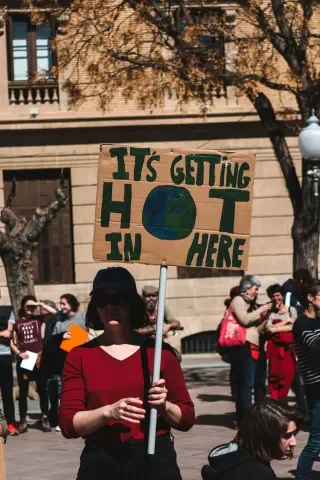
This summer, England's temperatures reached 99.9 degrees Fahrenheit, the highest June temperature on record in the UK. A heat wave triggered a "red heat health alert" at exactly the same time the city of London was hosting its 8th annual Climate Week. The irony here is obvious.
The British experienced cascading climate disruptions—nature's reminders to wake the heck up. The sweltering temperatures cut off vital transportation services, closed schools and businesses, and caused hospitals to restrict services as they struggled to cope with an influx of heat-related demands.
Beneath the immediate chaos, an urgent question looms: Can the British look up, notice, and care—even after these hot days finally pass? Can any of us?
As a psychotherapist working at the intersection of climate and mental health, I spend a good deal of time tracking emotional and behavioral responses to climate change across the globe. A new Yale Program on Climate Change Communication (YPCCC) poll reveals that a solid majority of Americans (65%) say that global warming is personally important to them. Yet, there is a high level of cognitive dissonance (or conflicting thoughts, feelings, and behaviors) as people struggle to reconcile fears, worries, grief, and hopes with ordinary life.
What I see happening in England, and many other countries, is something the YPCCC has called the "attitude-behavior gap." This is the fancy term for the very real discrepancy between human concern and climate action engagement. As YPCCC research indicates, even amongst those most willing to act (51%), few actually engage in political actions to limit global warming (6-16%), such as contacting government officials, attending protests, and signing petitions. This attitude-behavior gap is deeply problematic because human behavior tilts towards complacency at a time when climate collapse is accelerating.
What if we could harness the collective energy of the 89% global majority—who indeed want their governments to act—and effectively intensify collective pressure on world governments, institutions and businesses?
Here in the U.S., America's natural resources—including air, water, and public lands—are in jeopardy under the Trump administration, which has rolled back environmental protections and clean energy investments. This is precisely the moment that human concern for the environment and human health ought to be vocalized (ad nauseam) to build public pressure demanding government response.
In my clinical work, I've found that giving folks language for understanding the psychological mechanisms and structural barriers they encounter when it comes to the climate crisis is a helpful way of unsticking their psyches. Although there are many such barriers, a few key ones worth noting are: Noise, Depletion, and Intellectualization.
Noise
Noise is a catch-all for busy people leading busy lives—and/or oppressed and marginalized people leading oppressed and marginalized lives. Our busy-ness is no accident—it's by design. The inherent expectations of capitalism—efficiency, productivity, economic growth, and consumerism—effectively grind, entrap and distract us. Capitalism, as right-wing strategist Steve Bannon has identified, is an effective engine for breeding collective complacency ("flood the zone with sh*t)."
If we're honest with ourselves, can we admit that it's easy to be lulled into a state of submission, or remain frozen, or numb, entranced by a Pied-Piper-like spell that tells us to "keep looking away" rather than face the existential elephant in the room?
Just because people are distracted by noise does not mean that they don't care about climate change. People tend to assume that others around them don't care about the climate crisis, but this simply isn't true. A "perception gap" exists in which people tend to underestimate their fellow citizens' concern for the environment. In fact, polls consistently show that the majority of the global population does, indeed, want climate action and would even make personal sacrifices to help.
Additionally, a large segment of folks who care deeply about ecological destruction is too busy working jobs, feeding families, and eking out survival to have space or bandwidth to engage. The cost of living crisis suppresses the ability to act. In the U.S., notoriously sparse family-friendly policies (e.g. paid maternity/paternity leave, affordable healthcare and childcare) mean that that less resourced folks are overburdened with day to day concerns. Meanwhile, the middle class is kept saturated and distracted by a culture of consumerism. For those of us who are able to cut through this Noise, it is our responsibility to act.
Depletion
Depletion is a physical and emotional state of "running on empty" that stems from ambient Noise. It turns out that, eventually, living with constant over-stimulation and too little rest catches up with you. Long workdays. Second or third jobs. Cost-of-living struggles. Intense careers that don't allow you to clock out at the end of a long day. And, of course, the glaze-eyed exhaustion from the most demanding relationship of all—your smartphone.
The pings. The posts. The likes. The feeds. The shares. Smartphones demand our constant attention from the moment we wake up to the moment we go to sleep. A pervasive cloud hangs over our heads of "I just can't keep up" that leaves us feeling ragged at the end of each day. Burnout, at least in the US, is difficult to avoid.
Living in a depleted state is not healthy for anyone, including children, nor will it help tackle our climate crisis. To stay depleted means kicking the existential can further and further down the street -- rather than picking it up ourselves. A depleted society is not in any shape to look after its future generations.
Intellectualization
Perhaps the most subtle barrier to climate engagement is Intellectualization -- an interesting form of mental gymnastics subconsciously adopted to insulate people from the emotional pain of the climate crisis. On one hand, people are honest about the hard realities of the climate crisis, but on the other, climate emotions are kept at arm's length. When we shield ourselves from pain, heartache, fear, anger, etc., then we deny the emotional gravity of the situation. Yet, emotions are actually portals to motivation, care and engagement. By keeping those doors shut, we pay a price.
These are only three barriers to climate engagement. But keep in mind that Noise, Depletion, and Intellectualization are temporary traps. With intention, we can move past them and carve a path forward that will be meaningful, productive, and clarifying. This is the hope of climate behavioral change.
Simple Solutions
To combat noise, seek quiet. Try to spend time in quiet spaces—like libraries, book stores, museums, parks, forests, beaches or public gardens. Create a quiet zone in your home—for example, a porch, a seat near a window, a corner of a room that is discussed and agreed upon—or use a pair of noise-canceling headphones. Perhaps you set up some comfy pillows or put a sign up on the wall to designate a quiet space. If you live with others, consider creating an agreement to honor quiet hours each day (e.g., early morning, before bedtime). Consider making this quiet time device-free as well.
Building Quiet time back into our lives reminds us to slow down, reconnect with our thoughts and feelings, and to replenish ourselves. One of my clients starts each morning on his balcony with tea, another unwinds on her rooftop at the end of the day, watching the sunset. Granting our brains some breathing room will help us to internally settle and regroup, so that we stay connected to ourselves, and our values and priorities. And it keeps us sane, too.
To combat depletion, try replenishment. Dr. Saundra Dalton-Smith has identified 7 types of rest that every person needs (and it involves more than kicking your feet up at the end of the day). Yes, she mentions physical rest and mental rest. But she goes further, including sensory rest (i.e., shutting out overwhelming stimuli), emotional rest (i.e., honestly expressing your feelings), social rest (i.e., setting boundaries around toxic relationships), and spiritual rest (i.e., connecting to something larger than yourself). If ever there were a prescription for our current existential woes, it is this! We can't tackle climate change if we are not reasonably well-rested.
To combat Intellectualization, try emotional composting in your community or with a buddy or professional. We spend a lot of time avoiding our feelings because we're afraid of them and worry that they will consume us. In fact, it's just the opposite: our avoidant tendencies drive up inner tension and distress. The only way to experience relief is by honestly sharing our feelings. When we share our feelings with others, it's even more beneficial because we discover that we are not alone, and we can feel validated, and even motivated by one another. Emotional composting is a process of breaking down messy complex emotions into identifiable ones so that we move towards greater emotional attunement. From there, it's easier to act.
In order to effectively respond to the mounting climate emergency that generates heat waves, triggers extreme weather events and pushes us past dangerous planetary tipping points, then we must activate our quiet attention, we must find ways to replenish ourselves physically, emotionally and spiritually, and we must sit with our emotions in an honest way. This is a basic global prescription, regardless of where you are located.
When we understand the forces that keep us from acting—Noise! Depletion! Intellectualization! -- we can stop running in the same tired, predictable circles that perpetuate avoidance. And we can collectively address the climate crisis rather than leave it up to climate activists, professionals, and frontline communities. Our planet and younger generations desperately need us to wake up, stay vigilant, and act in alignment with our eco-concern. Now, more than ever. As humans, we have the power to modify our behaviors—and we can start today.

Ariella Cook-Shonkoff, MFT, ATR
Ariella is a licensed marriage and family therapist, registered art therapist, author, and speaker. She writes and teaches on climate anxiety, parenting, and building resilience in families navigating an uncertain world.